
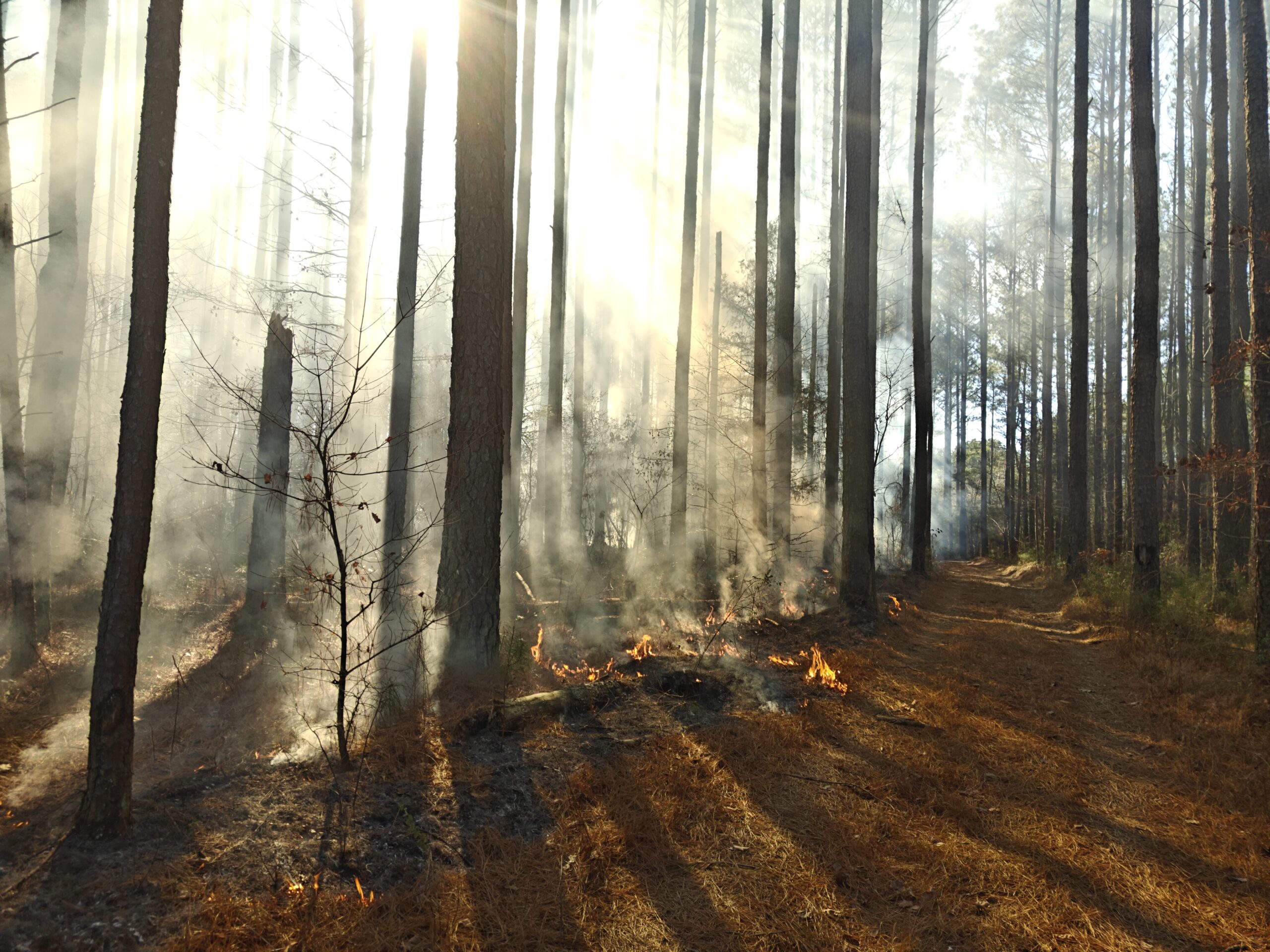
FLT kicked off 2026 by taking an exciting step forward in caring for Five Mile Creek Conservation Unit 4 (CU4) by reintroducing prescribed fire to the landscape for the first time in decades.
Located in a small community north of Birmingham, Five Mile CU4 is a 289-acre conservation property that was donated to FLT by Sloss Industries Corporation in 2006. The habitat features mature loblolly pine forests in the uplands and mixed hardwoods along the slopes leading down to Five Mile Creek.
In 2024, FLT identified this property as a priority site for some more intensive management efforts; its accessibility, favorable topography, and increasing risks from pine beetle infestations and wildfires affecting mature trees meant it was an ideal candidate.
Fire is a natural and essential part of Alabama’s forest ecosystems. When used intentionally and carefully, prescribed fire reduces excess vegetation, lowers the risk of destructive wildfires, and creates space for native plants and wildlife to thrive.
Implementation
FLT partnered with the Jefferson County Department of Health, Jefferson County Sheriff’s Department, Natural Resources Conservation Service (NRCS), and Further Forestry to conduct a prescribed burn on approximately 60 acres of the site. The full project area totals 100 acres and will be managed on a two to three year fire cycle moving forward. Funding for this project was supported through a three-year NRCS Environmental Quality Incentives Program (EQIP). This funding supports habitat improvement activities, including firebreak construction, prescribed fire treatments, timber stand improvement, and invasive species control.
Because the property had gone so long without fire, pine straw and other fuels had built up across the forest floor. To ensure safety and effectiveness, FLT began by burning only half of the project area. The remaining acreage is planned for treatment later this year.
FLT’s Land Stewardship team, Sam McCoy and Spence Overton, were on site to plan, ignite, and monitor the burn. Extensive preparation took place beforehand, including constructing firebreaks, clearing fuel material near roads and utilities, and removing debris.
“One focus was to clear out the understory, because understory health is directly related to wildlife health and habitat,” said FLT Land Stewardship Coordinator Spence Overton. “By burning the understory, we’re killing invasives and allowing native vegetation and wildlife to thrive.”
Getting Conditions Just Right
Conducting a safe prescribed fire depends heavily on the weather. On burn day, temperatures, humidity, wind, and atmospheric conditions all had to fall within a narrow, specific range. These factors help the fire move slowly and predictably, allow smoke to rise and disperse, and protect mature trees from heat damage.
The result is a controlled burn that consumes excess fuel without exposing bare soil; an important balance for healthy forest recovery.
Fire Benefits you Can See
Almost immediately, the benefits of the prescribed fire treatment became visible: wild turkeys were spotted in the days following the burn, foraging in the newly opened forest floor for seeds and insects. Deer, squirrels, rabbits, songbirds and birds of prey are also expected to benefit from the improved habitat conditions.
As the forest responds and regenerates, FLT looks forward to watching fire restore balance to this landscape and expanding prescribed burning as a key stewardship tool across our conservation lands.
What’s Next for Five Mile Creek
Prescribed fire is just one piece of a broader management plan for Five Mile CU4. Additional efforts will include selective thinning of pine stands, invasive species control, and replanting in targeted areas. Based on soil testing, longleaf pine, a fire-adapted native species, is a strong candidate for future restoration work.
“We’re happy to have completed our first prescribed fire,” said Spence, “it’s one of the most effective ways to manage conservation land, and we’re excited to continue applying this method at Five Mile Creek and across other FLT properties.”