With October bringing more pleasant temperatures and mild changes to foliage, I was looking forward to tagging along for the annual monitoring survey of one of our long-held Blount County conservation easements. For this monitoring visit, I joined FLT’s newest full-time hire, Josh Logan (GIS and Land Stewardship Coordinator) to survey the 80-acre conservation easement (CE) we’ve had under our forever care since 2006, when the landowner partnered with Freshwater Land Trust to conserve land she’d acquired on the Locust Fork River.
The sweet landowner, a spry 80-something in age, and Moonpie, her cute and curious heeler mix, were outside as we pulled up. The landowner has lived on the property since 1991. Her house, built mostly of wood with a charming upper-level porch that makes it appear a bit like a treehouse, was built by a small crew of friends and community members.
The landowner joins us for our monitoring surveys every year, but this is the first time for Moonpie. They lead the way from the garden across a small sunny field and into the trees. A portion of this northern part of the property had once been pasture, and in the decades since animals grazed here, a thicket of Chinese privet crept in. Residents of the community now help in stewardship of the property and have been chipping away at the established invasive vegetation to return this area to a hickory and oak forest. We’re told that, despite the presence of the problematic species, the landowner finds that morel mushrooms seem to really like the conditions; silver linings, as they say!
A forest comprised mainly of cedars, pines, maples, and beeches leads us to Frog Pond, where apparently, armadillos have been seen “by the herd!” Moonpie races to the far side of the pond and joyfully splashes her way back. The composition changes markedly from here as we pass a second pond and make our way to the banks of the Locust Fork at the southeastern part of the property. A high-quality mix of species surrounds us: white and chestnut oaks, black gum, shagbark hickory, red and sugar maples, tulip poplar, hophornbeam, parsley hawthorn, ash, pines, and elm. Signs shaped like ducks signal subtle intersections, pointing to “Trickle Creek” and “Falls”. There’s about five miles of trails on the property.
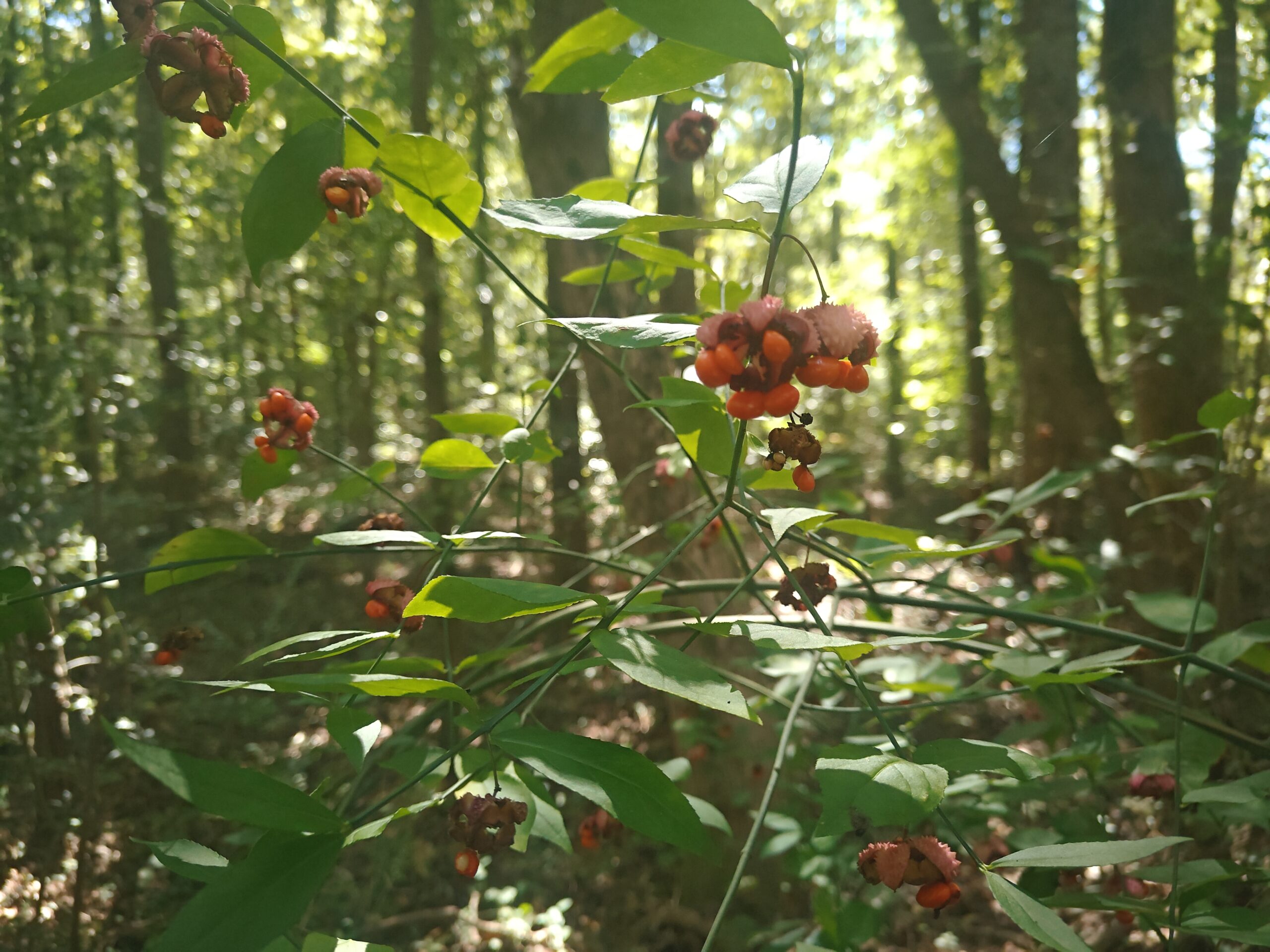
We come upon the site of “the three majesties”, what the landowner calls three enormous white oaks that grew near each other in a part of the forest reached by an undulating mossy trail. Sadly, one of them came down earlier this year, leaving a gaping hole in the canopy that will one day be patched by a younger one nearby. We follow a small creek across terrain that had long ago been terraced for agriculture. It’s now dotted with oak leaf hydrangea, azaleas, sassafras, paw paw, and some of the happiest (largest) hearts-a-bustin’ I’ve ever seen. Our host points out other plants nearer our feet. She knows a lot of the species on her property and refers to them by their latin name; she says she learned them as a way to “get to know [her] neighbours”.
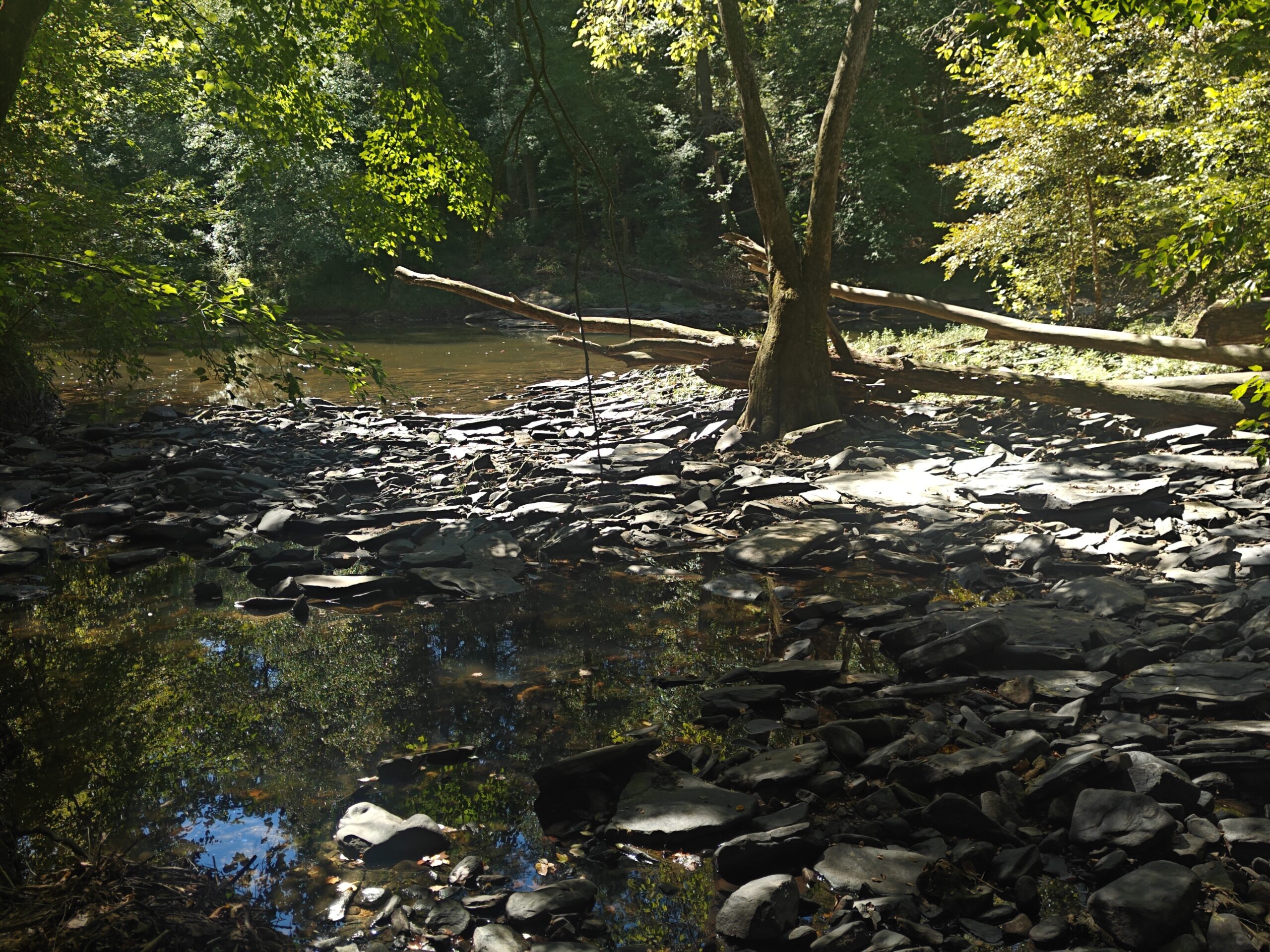
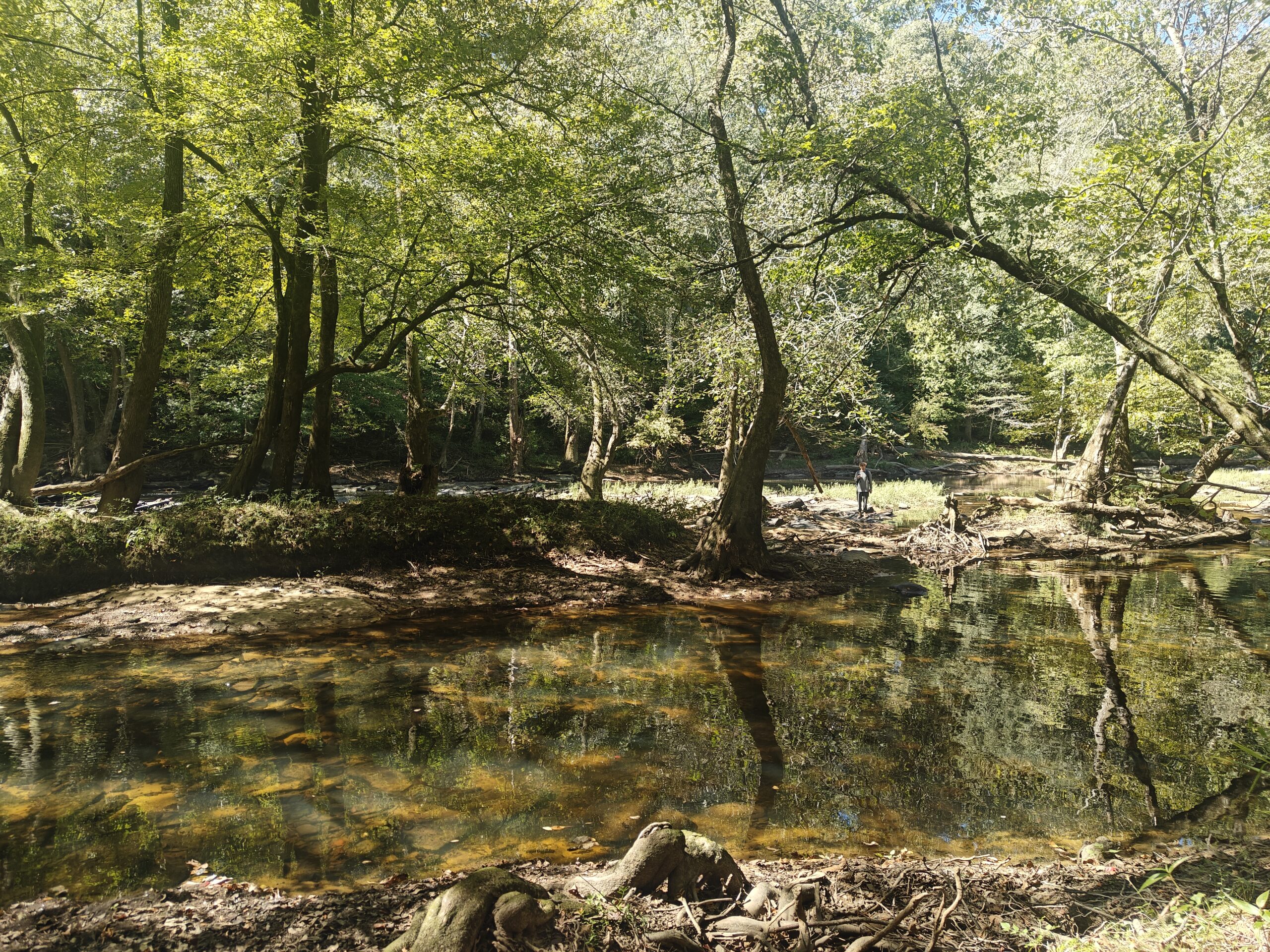
At the banks of the Locust Fork, we stand on a sandy ridge amongst ironweed, phlox, and river oats, looking down into a tupelo shoal where large, scattered slabs of sandstone lie. They’re dark in colour, as if oxidized or charred. The tupelo gums and sycamores create a grove that stretches from these stones across the water. We stand and watch the light bounce off the ripples for a while before turning to take the trail back to the house.
Moonpie stands beside us grinning, sandy and wet, as we say our goodbyes and “see you next year’s”. Protecting this place with Freshwater Land Trust, our kind landowner says, “is the best thing I ever did”. For us, it’s the relationships with people like her that makes our work so meaningful.